
Home › Services › Ceramic Coating
3303 W. Michigan Ave, Jackson, MI 49202
9H Ceramic Coating in Jackson, Michigan
Years of protection instead of months, applied by the people who already know your paint.
Talk to our body shop(517) 787-7509
A 9H ceramic coating is a liquid polymer that chemically bonds to your vehicle’s clear coat and cures into a hard, hydrophobic layer. At Jim Winter Auto Body in Jackson, Michigan, we decontaminate and correct the paint first, then apply the coating in a controlled environment. Expect several days in the shop and years of protection, compared with the two or three months you get from wax.
Straight answer first
What 9H actually means
9H is the top of the pencil hardness scale, a lab test that measures how well a cured film resists being marked by graded pencil leads. It is a real measurement, and it is worth knowing what it is not.
It is not the Mohs mineral scale. A 9H coating is not approaching diamond, and no coating makes paint scratch-proof. What it does deliver is a hard, glass-like layer that shrugs off the light swirls and wash marring that dull a finish over time, plus a surface that dirt and salt struggle to stick to.
We would rather tell you that up front than have you discover it after a stone off I-94.
What a coating does and does not do
- Resists light swirl marks and wash marring from normal use
- Protects against etching from bird droppings, tree sap, and hard water spots
- Blocks UV exposure that fades and oxidizes paint over the years
- Makes road salt, brake dust, and winter grime release with far less effort
- Adds real depth and gloss to a corrected finish
- Does not stop rock chips, deep scratches, or door dings. That is paint protection film and bodywork.
- Does not repair existing defects. Whatever is in the paint gets sealed under the coating.
Comparison
Coating, sealant, or wax
All three protect paint. They are not close to the same thing.
| Carnauba wax | Synthetic sealant | 9H ceramic coating | |
|---|---|---|---|
| Typical lifespan | Weeks to 2 months | 4 to 6 months | Years |
| How it holds on | Sits on the surface | Bonds loosely | Chemically bonds to clear coat |
| Water behavior | Beads at first | Beads and sheets | Strongly hydrophobic, sheets off |
| Swirl resistance | None meaningful | Slight | Meaningful against light marring |
| Rock chip protection | None | None | None. That is paint protection film. |
| Prep required | Wash | Wash and decontaminate | Decontaminate and correct |
| Time in shop | Under an hour | A few hours | Several days |
Process
How we apply it
Most of the work happens before the coating ever comes out of the bottle.
Assess the paint
We look at the finish in proper light and tell you what condition it is actually in. Failing clear coat needs refinishing, not coating.
Wash and decontaminate
A clay treatment pulls out embedded contaminants that washing leaves behind, then the surface is stripped of any old wax or sealant.
Correct the finish
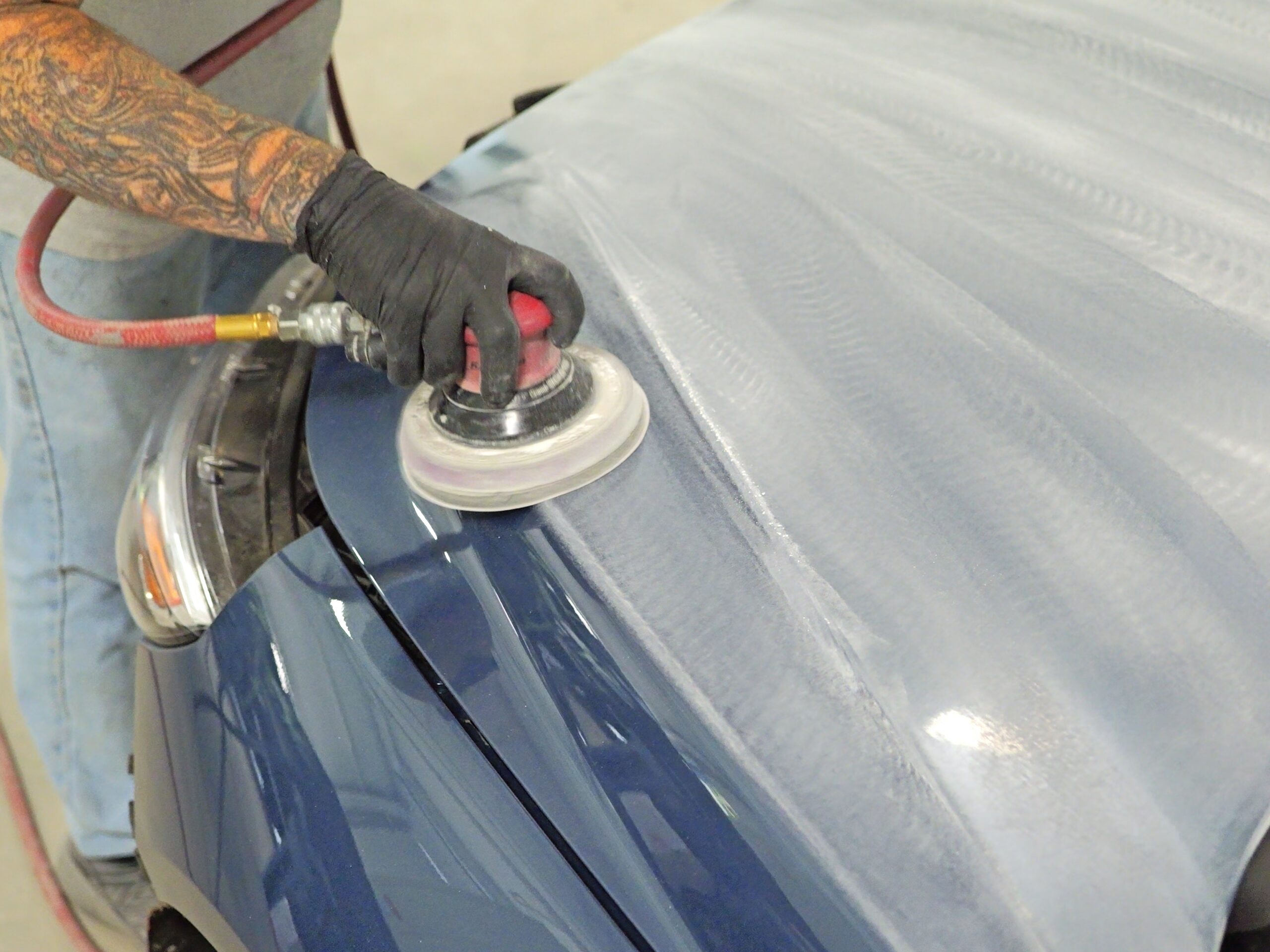
Swirls and light defects are polished out. Whatever is left at this stage is what the coating will lock in, so this is where the time goes.
Panel wipe
An alcohol-based wipe removes polishing oils. Skip this and the coating bonds to residue instead of clear coat.
Apply the coating
The 9H coating is applied panel by panel in a controlled space, then leveled before it flashes.
Cure and inspect
The coating hardens before the vehicle sees weather. We inspect under lights, then walk the finish with you at pickup.
If we just repaired your vehicle
Fresh paint has to cure first
This is the part most people do not expect, and it is the reason a body shop is the right place to have this conversation.
Refinished panels keep releasing solvents after they leave the booth. Seal that surface too early with a coating and those solvents are trapped underneath, which can affect how the finish cures and how it looks a year later. The wait is typically 30 to 90 days depending on the product and conditions.
If we refinished your vehicle, we know exactly when it was sprayed and what went on it. We will tell you the right window and book you in when the paint is ready, rather than selling you a coating on the day you pick the car up.
Aftercare
Keeping the coating working
- Wash with a pH-neutral soap and two buckets, or hand wash at a touchless bay
- Avoid automatic brush washes entirely. They put swirls into coated paint the same as uncoated.
- Rinse road salt off through the winter rather than letting it sit
- Do not apply wax over the coating. It does nothing useful and dulls the hydrophobic effect.
- Remove bird droppings and sap promptly. The coating buys you time, not immunity.
- Bring it back for inspection if water stops sheeting the way it did
Questions
Ceramic coating questions we get asked
What does 9H mean on a ceramic coating?
9H is the top of the pencil hardness scale, a lab test that measures how resistant a cured film is to being marked by graded pencil leads. It is not the Mohs mineral scale, so a 9H coating is not close to diamond hardness. What it does mean in practice is a hard, glass-like cured layer that resists light swirls and wash marring far better than wax.
How long does a ceramic coating last?
A professionally applied 9H coating typically lasts several years rather than the two or three months you get from wax. Actual life depends on how the vehicle is washed, whether it is garaged, and how much salt and sun it sees. Michigan winters are hard on any finish, so a vehicle washed with pH-neutral soap and kept out of brush washes will hold up considerably longer.
Will a ceramic coating stop scratches and rock chips?
No, and any shop that tells you otherwise is overselling it. A coating adds a hard sacrificial layer that resists light swirl marks, wash marring, and etching from bird droppings or hard water. It will not stop a stone off the highway, a shopping cart, or a key. For rock chip protection you want paint protection film, which is a different product.
Can you coat a vehicle that was just repainted?
Not immediately. Fresh paint continues to release solvents as it cures, and sealing it too early traps them in the finish. We wait until the refinish has fully cured before coating, which is typically 30 to 90 days depending on the product and conditions. If we repaired your vehicle, we will tell you the right window and schedule it.
What is the difference between ceramic coating, wax, and sealant?
Wax sits on the paint and lasts weeks to a couple of months. A synthetic sealant is more durable and lasts several months. A ceramic coating chemically bonds to the clear coat and cures into a hard layer measured in years. The cost order matches the durability order, and the coating is the only one of the three that meaningfully changes how easily the vehicle cleans up.
Do I still have to wash my car?
Yes, but it gets easier. Dirt, brake dust, and road salt have a harder time bonding to a coated surface, so most of it releases with a rinse and a pH-neutral wash. Skip automatic brush washes, which are the fastest way to put swirls into any finish, coated or not.
Will a coating fix swirl marks and scratches that are already there?
No. A coating locks in whatever condition the paint is in when it goes on, which is why paint correction comes first. We assess the finish and correct what can be corrected before any coating is applied. Coating over neglected paint just seals the defects under a hard, long-lasting layer.
Can it be applied to wheels, glass, and trim?
Yes. Wheels benefit as much as paint does, because brake dust has a hard time bonding to a coated surface. Glass coating improves water shedding in rain, and trim coating helps keep plastics from fading. Tell us what you want included and we will price it accordingly.
How long does the vehicle need to stay with us?
Plan on a few days. Decontamination and paint correction take the bulk of that time, the coating itself goes on in a controlled environment, and then it needs to cure before the vehicle goes back into weather. We give you a firm pickup time when you book.
Is a ceramic coating worth it on an older vehicle?
It can be, as long as the paint is sound. If the clear coat is already failing or peeling, a coating will not save it and refinishing is the honest answer first. On an older vehicle with healthy paint, a coating is one of the better ways to protect what is left and keep it easy to clean.
Related services
Also handled in house
Protect the finish you just paid for
Call us for a look at your paint and an honest read on whether a coating makes sense for your vehicle.